
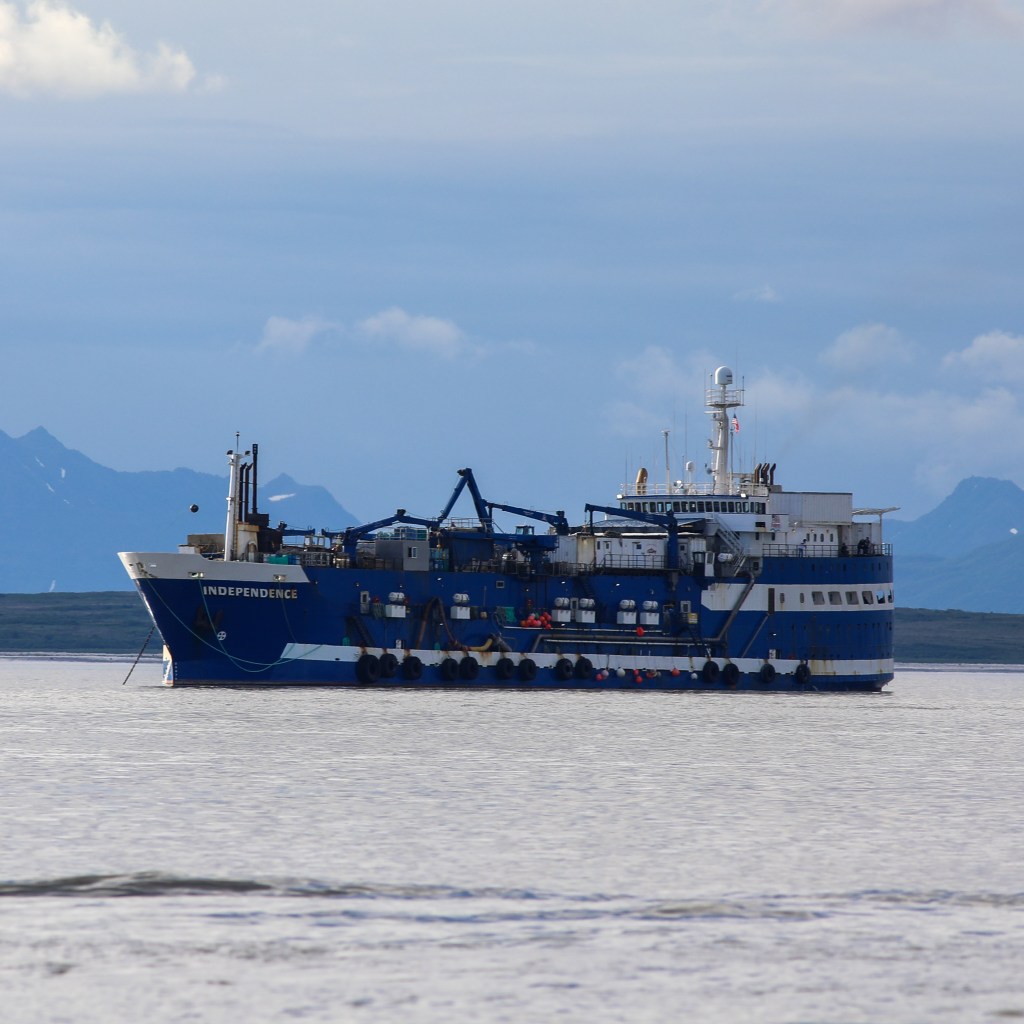
As the sun rose on the damp, cold winter morning nearly 200 hundred people gathered outside a chain-link fence in the Port of Tacoma quietly chatting with heavy suitcases and duffle bags in hand. The dark silhouettes of large ships finally filled in with color and detail, but I was still unable to determine which one we’d be boarding later that day. I was nauseous with apprehension. Things hadn’t gone as planned, other jobs had fallen through and I was stuck with my last resort of working as a seafood processor on the Bering Sea.
When the gate finally opened there was a mad rush to be in the front of the line, myself and a few of newcomers didn’t realize just how long the wait would be if we were caught at the end. We were abrasively ordered to form a single-file line; yellow caution tape was then used to create our pen. Forklifts buzzed back and forth unloading a few months worth of food for the 250 or so people who would be living aboard.
I looked around and saw a veritable United Nations of low-wage workers: Somalis, South Sudanese, Filipinos, Samoans and other Pacific Islanders, francophone-Africans, a few Arabs, a smattering of Mexicans, and a handful of Americans among others. We were all ready to give our labor for $7.75 an hour, but for that we had to give up our lives for the next four to six months. All free time would be spent sleeping, eating or fraternizing onboard a large floating factory on the Bering Sea. We’d be lucky to set foot on land four times in the coming months.
I met a guy at the tweaker motel I had stayed at earlier that morning who was to work on the same ship. We shared a cab to the Trident Seafoods facility and found ourselves in line with each other for a few hours. He was a nondescript white guy from southern California and had worked in Dutch Harbor at a processing plant the previous summer. He told me he got fired from a different seafood company for getting in a fight with a few Filipinos.
“You know how it goes up there, people like to fuck with you because you’re white,” he said to me assuming I too had been the victim of some “racial injustice” in commercial fishing.
We chatted a while longer, but he quickly bored me. I found myself judging him harshly, but then I realized we were both on the same boat, literally. We were two middleclass white guys in the twilight of our youth without great prospects, we both felt compelled for one reason or another to take a job that would scrape us along the poverty line in the icy waters of the North. Still, I had to walk away from him. I didn’t want to start the season with someone who already had a racial chip on his shoulder as my buddy.
Our handlers starting hollering at us for not being in single file, the mob shuffled around and I took the opportunity to jump up a few spots and immerse myself in a different group. There were two young white guys and two middle-aged ladies, one African American and the other Latina. They had all worked with each other the previous summer as processors.
“You just have to stay with your race and you’ll be fine,” said a guy about 21-years-old. “White people stay with the few other white people, Africans with the Africans, and so on. You’ll meet everyone and you’ll make plenty of friends with other people, but stick with the us whities to start.”
“Whities?” I said with a sheepish grin looking around at our mixed company.
“Yeah, that’s an inside joke,” responded Elaine an African-American woman from southern California. “Around here, if you were born in the States and speak without an accent you’re pretty much a whitey.” She went on to recount a few comical stories about her interactions on the ship with African men as an African-American woman.
The sun grew high in the sky as the line slowly moved along. In the finished office of the sheet-metal warehouse about seven people at a time were signing contracts and showing work visas. At 10:30 a.m. my fellow multi-racial whities and myself finally entered the building after standing in the cold for more than four hours.
Elaine and our Latina friend Cynthia were both wearing tight jeans and knee-high leather boots with three-inch heels, their spirits were up, but both were cold and uncomfortable. Even though they were about to process dead fish for to next six months, they still wanted to look good as they boarded.
My apprehension was subsiding, but it was slowly being replaced by a more foreboding sensation of dread. Cynthia had brought along her pay stubs from the previous season. She showed me a few that ranged from $300 to $500 for two-week pay periods. Hours weren’t guaranteed; if the fishing were bad there would be no fish to process. And if the fishing were below average, the recent hires would have to struggle for shifts. If you’re not working, you’re still on the boat with little to no communication with the outside world.
Earlier I had calculated that I would need at least 80 hours a week for four months to walk away with about ten grand after taxes. While it was still a possibility, it was also an equally strong possibility that after four to six months of servitude I would walk away with five grand. The dread was beginning to manifest itself physically, like butterflies in the stomach but not at all pleasant.
The previous January I had made ten grand in less than two weeks Dungeness crab fishing on the Washington coast. Now I was looking forward to a two-week boat ride to the Aleutian village of Akutan and I would be lucky if I made that over the course of the season.
I had given up my former job in September. After nearly 18-months of living and working on the same boat I felt I needed a change. I thought I had a few options for work on other boats in different fisheries. But one by one they fell through. I had contacted Trident Seafoods, one of the largest seafood companies in the country, about working on deck on one of their company boats in the Bering Sea. I was given a standby position, if any deckhand left their job or failed to show I would then be given a spot on deck fishing for crab and cod. Unfortunately, the entire crew returned so I was offered the less glamorous job of seafood processing.
Countering my dread was my growing affinity for my soon-to-be coworkers. While the clicks and groups that made up the early interaction were based on ethnic and linguistic identities, personal interactions didn’t seem to be at all stifled by them. We were all going to be underpaid and exploited chattel for the coming months. Capital and corporate bottom lines, while not completely color blind, are equal opportunity exploiters of those at the bottom. That said, I was one of few there that would ever be given the opportunity to move within the ranks, from exploited to exploiter.
We finally made our way to the top of the stairs, after five hours in line. Ten feet from the office where the processors were being processed, there was a Jamaican man enthusiastically preaching pan-African unity with a man from South Sudan and another from Mali. There were lots of smiles and agreeable nods of the head from the two men from Africa, but the Jamaican’s pidgin English seemed too much for them to grasp. Michael, the Jamaican, saw Elaine and opened to include her into the conversation, and by default me.
Other than Elaine we were all first time processors, the two men from Africa had both found the job through a recruiter. Recruiters take a cut of the pay, I’m still researching whether or not this means that those hired from a recruiter are actually paid less than minimum wage.
Two years earlier I had met two young Ukrainians at a hostel in Seattle. They had been recruited in their country to work at a processing plant in the Aleutian Islands for a summer. Being two young men struggling with English and no one else they could communicate with during a particularly slow summer, they found it very difficult to pick up enough hours. After they had reimbursed their recruiter for airfare and other fees they found themselves broke after a summer of work. They had made there way back to Seattle and were down to their last $50. Their flight back to the Ukraine left from New York in a week, but broke in Seattle they lacked funds to make their way across the country.
Back in the line we were all sharing our hopes and our fears about the coming months. The Africans had said they had never spent a winter in a cold climate, and the Michael had only spent a winter in New York, which is said was miserable.
While working for minimum wage isolated on a ship, with an overtime rate that wouldn’t count as a living wage in most American cities seems abysmal to most, the prospect of bringing $10,000 back to Mali, South Sudan or Jamaica seemed well worth the struggle and sacrifice for my new coworkers. I say this not as an apology for poverty wages, but for the reality of the situation.
Six months of work could make for very comfortable living for migrant workers from some of world’s poorest countries. According to IMF estimates, the nominal per capita income of Mali was $796 for 2011, $1,939 for South Sudan (although this number includes the oil-wealthy north Sudan as well) and $5,376 for Jamaica. The man from Mali would likely earn ten times the per capita income of his homeland. That would be like me earning $481,470 for my work on the floating factory.
But there was prominent immigrant group missing, which I think was very telling of the labor conditions. There were hardly any Mexicans. In my summers fishing for salmon in Southeast Alaska the vast majority of the cannery workers were Mexican. Given their sheer population, Mexicans without papers make up the largest proportion of workers who face illegal work conditions and labor practices—no person is illegal but the conditions they face can be. Partly for the reason of strict enforcement of valid work visas and partly for the fact that those who have papers know a bad deal when they see one, my Mexican brethren were largely absent.
I finally made my way into the office to be processed at around 1 p.m. After about five minutes I was told that I myself lacked the proper documentation. I only had a driver’s license; I had left my social security card and passport in California. I was told I would have to go to the Social Security office in Tacoma and be able to make it back before the ship departed with proof of my social security number.
I never had to hustle more for a job I didn’t really want. After I was told that I would be unable to work on deck I was offered a processing job and my application was sent to a different recruiter. I took a drug test as part of the application process and filled out a medical disclosure form. I then waited for confirmation. Weeks passed and I hadn’t heard anything. I knew the ship would depart in early-January. New Year came and went and I still no response; my voicemails and emails were all ignored. When I had gotten someone of the phone I was told to wait for an email. I was only able to pry out of a secretary that the ship would be departing on January 6.
I bought a plane ticket to Seattle for January 5. The morning of my flight I still had no confirmation. I finally got someone on the phone who told me I had a job and that the ship was in Tacoma. I was emailed a link to sign my contact electronically. I filled out the necessary info but was dismayed to find the actual contracts were in an unreadable jsp file, so I actually had no idea what I was signing. This, I believe, was illegal.
I made my way to Tacoma and got a motel room close to the facility, I only knew the location thanks to Google Maps. By the time I went to bed the night before I was to depart I still hadn’t received an official confirmation or any boarding itinerary. I woke up at five that morning and called every number for Trident I could find and finally was told to be at the facility at 7 a.m.
I headed off to call a cab and was steaming about spending $80 for a round-trip taxi ride. It was a boneheaded oversight on my part. Of course I would need two forms of ID in this industrial setting, but for the mom and pop boats I had worked on before a state ID was more the sufficient.
The taxi driver who brought me from the Social Security office to Trident was a jovial man from Djibouti. He made a quick point to say he was an Obama supporter and was enraged at those who blamed the president for the economic mess and not Bush. I didn’t mention Clinton’s large role in the fiasco.
When I had mentioned I was headed up to Akutan on a processing ship he smiled and chuckled.
“Lots of work and little money,” he said. He had worked on a land-based plant in Akutan for two seasons a half-dozen years ago. He made a few derogatory remarks about the nondescript “lazy Asians” who he had worked with.
“If you work one season you won’t make any money,” he said eying me from the rear-view mirror. “You work three or four seasons in a row, then maybe you have some money.”
The feeling of dread was increasing again. I hadn’t spent the past three years working on boats for the love; I did it for the money and coincidentally found a few things I loved about it. What I loved was the natural splendor and the body and mind’s struggle against the brutal elements. Locked up on the ship I would find none of that I loved and none of the money that I needed.
The man from Djibouti wished me luck and gave me a handshake as he dropped me off at the Trident facility. I walked back into the office to finish the paperwork. I mentioned the contract signed online was only available in an unreadable jsp file. They didn’t respond. I expressed a little frustration with the lack communication; they told me I was lucky to have a job.
My body was beginning to come to the conclusion my mind didn’t want to acknowledge, the thought of walking on to that boat began to physically pain me. My “whitie” crew was at some other step in the boarding process. I completed a hearing test and went off to a safety training.
When I decided to take the job I was under the impression that it was a four-month commitment, I was dismayed to find the contract was for six months. Six months would cut into salmon fishing in the summer, a relatively high paying fishery. To make $10,000 in the winter I might have had to forgo $25,000 in the summer.
I could always quit at anytime, but there were many incentives to stay until the completion of the contract: a ten percent bonus, a refund of $10 for every $15 paid to the company for daily accommodation on the ship, and most importantly a paid ticket back to Seattle. If I were to quit I would have to pay for my own transportation back to Seattle from Akutan, a trip that would cost an easy $1,500.
The dread soon mixed with self-loathing. Was this really where my life was at, working for $7.75 an hour on a slave ship? I had no other options on the table, a bank account in the red and no unemployment to fall back on. One’s wage is their value to society when viewed through the all-encompassing lens of capital.
I sat in a hallway waiting in yet another line and observed those around me. Some were quietly chatting amongst themselves, others were staring at the ceiling and others saying their final goodbyes to friends and loved one’s on their cell phones.
Oh the irony! For all my ideals on equality, of creating truly egalitarian bonds and economic relations between all peoples, I couldn’t stand to let myself be equally exploited.
I got up and went down to where one of the managers was talking with a few mates. I made my case, I told the manager I had serious reservations of getting on the ship. It was the same man who had interviewed me a month prior in Stockton, California when I was the sole white guy amongst more than a 100 Filipinos. For that reason he remembered me. The fat-ass had trouble distinguishing one brown face from another, but he would always remember the few whities in the sea of black and brown. I reiterated my experience and how it would be a waste of my skill to work below deck.
The looked at me with forced sympathy. He told me I should stick it out, that I after one season below deck I would likely find a higher-paying job on deck.
“You’ll definitely stand out and prove to be one of our top workers,” he said. “Plus you’re one of the only ones who speaks English. But, if you do walk away now you’ll never be hired by us again.”
“Fuck that and fuck you,” I said cowardly under my breath as I left the room. He was wrong on so many levels. He took people’s accented English as being a complete lack of English. Furthermore, I’m down for paying my dues, but as long as I’m adequately paid in the process.
I grabbed my duffle bag from the warehouse then found my recruiter to tell her I was leaving. She said it was better to quit now than to get on the boat and quit in Akutan. Then she asked me why I had even gone through the trouble of coming up to Tacoma in the first place. It was a good question. I really needed a job, I said, but I realized this job would interfere with other more lucrative deck jobs.
I made my way to the road. All I could see was concrete, chain-link fences topped with razor wire, shipping containers stacked high and large cranes in the distance. In 2010 the port handled roughly $28 billion in international trade. While well paid unionized labor handles the trade in U.S., nearly all of the profit from it is built off that poverty wages of those at the bottom, whether in large factories in China or picking produce in Washington’s Yakima Valley.
In the U.S. we give our most undesirable jobs to migrant workers, whether undocumented or on “guest” work visas. This is not simply because U.S. citizens do not want the jobs, but for another more insidious reason. Guest workers have zero political power. They are unable to vote and are thus ignored by politicians. If they were to strike they would likely have their visas revoked and sent back to their home countries. There is always the international reserve army of labor to take their places, for whom minimum wage is a relatively high wage.
Large seafood processors and agricultural businesses use guest workers because it is nearly impossible for them to unionize. The companies reap huge profits off the backs of the world’s poor, adhering only to the bare minimum of U.S. labor law. They do not have to worry about medical benefits, living wages, retirement plans or anything else workers normally demand through collective bargaining.
There is an alternative. Seafood processors in Canada are largely unionized, in turn, most workers are permanent residents or citizens. While I’m currently researching the situation, it seems that Canadian seafood companies have remained competitive globally. Though unfortunately, unions themselves often act as relics of a bygone era.
After about a mile I grew tired of my heavy load and put my large duffle bag on the ground and stuck out my thumb. After a few minutes a large mustachioed man in a Chevy Suburban stopped to give me a lift. He asked me what boat I was getting off; he had assumed I was a merchant marine. I told him I was not getting off any boat, but that I had walked away from one. I gave him my spiel. He told me that was no job for an American, and then told me I should look for union work. He himself was a longshoreman. I asked him how I could make my way into the ILWU. He told me I should marry the daughter of a longshoreman.
“You have a daughter?” I asked with a grin.
“Yup, but she’s married,” he said looking at me through a cloud of cigarette smoke. “Her husband is now a longshoreman.”


 outside-in
Leave a reply to matt Cancel reply